Meaning,
Not Noise.
Why Shared Meaning Matters in the Age of AI
AI is helping people accomplish more on their own. But what happens when all that good work starts pulling an organization in different directions?
Meaning, Not Noise introduces Shared Meaning—a common understanding of what an organization stands for and where it's headed. It gives people and the AI they use a shared point of reference, creating the foundation for Organizational AI Alignment.
Explore the idea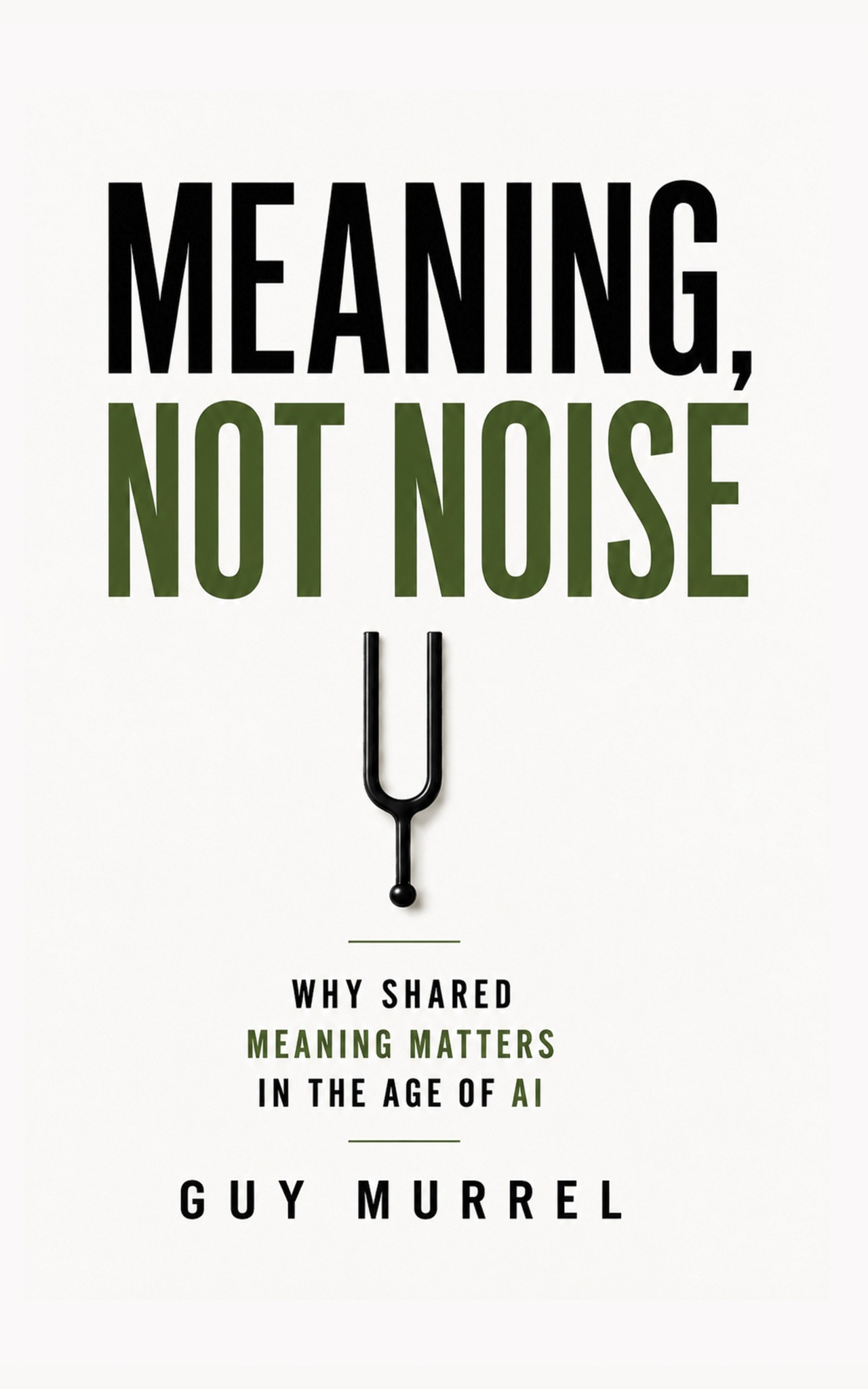
The Context Behind Organizational AI Alignment
Organizations invest considerable effort in defining their strategy, positioning and messaging. But those insights don't always guide everyday AI-assisted work consistently.
Organizational AI Alignment helps people and the AI they use work toward a common organizational direction, so greater individual productivity contributes to progress for the organization as a whole.
Shared Meaning provides the organizational context needed for that alignment. Organizational AI Guardrails help put it to work in everyday decisions and assignments.
Guardrails That Guide, Not Control
Generative AI predicts responses rather than following a fixed set of rules. It can make things up, draw unsupported conclusions or be led astray by misleading prompts. Anyone who regularly works with AI has probably experienced some of this.
Now multiply that across an organization. People bring different perspectives, assumptions and ways of working with AI. As AI helps everyone accomplish more, the potential for confusion, conflicting signals and unnecessary rework grows.
While traditional AI guardrails focus on managing risks and preventing unwanted behavior, Organizational AI Guardrails serve a different purpose. Instead of prescribing how everyone should work, they help people and AI recognize uncertainty, question assumptions and navigate conflicting directions—so individuals can work independently while their efforts contribute to something greater.
The context AI needs comes from people.
What an organization stands for isn’t captured in a single document. It shows up in the problems people solve, what they learn from customers, and how they work with one another.
AI can help uncover patterns in those experiences, but people must decide what they believe, why their organization exists, and what future they want to help create. Together, those decisions form what I call Shared Meaning.
Try it for yourself.
The ideas in Meaning, Not Noise are meant to be put to work. These free resources help you explore Shared Meaning, bring different perspectives together, and give AI better organizational context.
Notes on meaning and work.
I'll share ideas, observations and lessons from exploring Shared Meaning, working with AI and thinking about what it means for organizations.
Visit the blogWork with Guy
The ideas in Meaning, Not Noise are meant to be put into practice.
AI Meaning Facilitation
I work with leadership teams to discover and articulate Shared Meaning, combining AI-assisted individual discovery with facilitated discussion. The goal is to develop a common understanding that helps people exercise their own judgment while working toward a shared direction.
That understanding can also provide a foundation for Organizational AI Guardrails.
Answer Engine Optimization (AEO)
I help organizations strengthen how they're understood and represented in AI-powered search. Drawing on my background in strategic narrative and communications, I focus on making an organization's perspective, expertise, and value easier to discover and accurately interpret.
If either of these challenges is relevant to your organization, I'd welcome a conversation.
Email Guy